

Production AI & Integrations That Hold Up in Real Use
Build reliable AI workflows, customer integrations, data pipelines, and product automation inside the systems your customers and team already depend on with explicit handling for failures, human review, and production operations.
Production AI workflows · APIs · Product integrations · Data pipelines · Reliability
When the Workflow Matters, Reliability Matters
Production AI and integrations have to keep working when APIs fail, data arrives in unexpected formats, model output varies, or external systems slow down.
Product Integrations
Customer and partner APIs, webhooks, authentication, syncs, and external product systems.
AI & Data Pipelines
Extraction, classification, enrichment, structured outputs, and model-backed processing.
Reliability & Failure Handling
Retries, queues, idempotency, fallback paths, rate limits, and recovery.
Human Review
Keep judgment visible when AI confidence, business rules, or workflow risk requires human involvement.
“No-code where it works. Custom engineering where it matters.”
Engineering for the Work That Moves Through Your Product
Some bottlenecks sit inside customer workflows, others between your product and external systems. We engineer the integrations and AI pipelines that connect them reliably.
Customer & Partner Integrations
APIs, webhooks, data synchronization, authentication, and partner/customer systems.
Document & Data Processing
Ingestion, extraction, normalization, validation, and structured data workflows.
Production AI Workflows
LLM-backed classification, analysis, decision support, generation, and structured outputs.
Payments & Transaction Workflows
Billing events, webhooks, reconciliation, retries, and downstream product actions.
Messaging & Customer Operations
Email, SMS, voice, notifications, and workflow-driven customer communication.
Internal Product Operations
Admin workflows, operational tooling, approvals, exception handling, and human review.
The Workflow Is More Than the Automation Tool
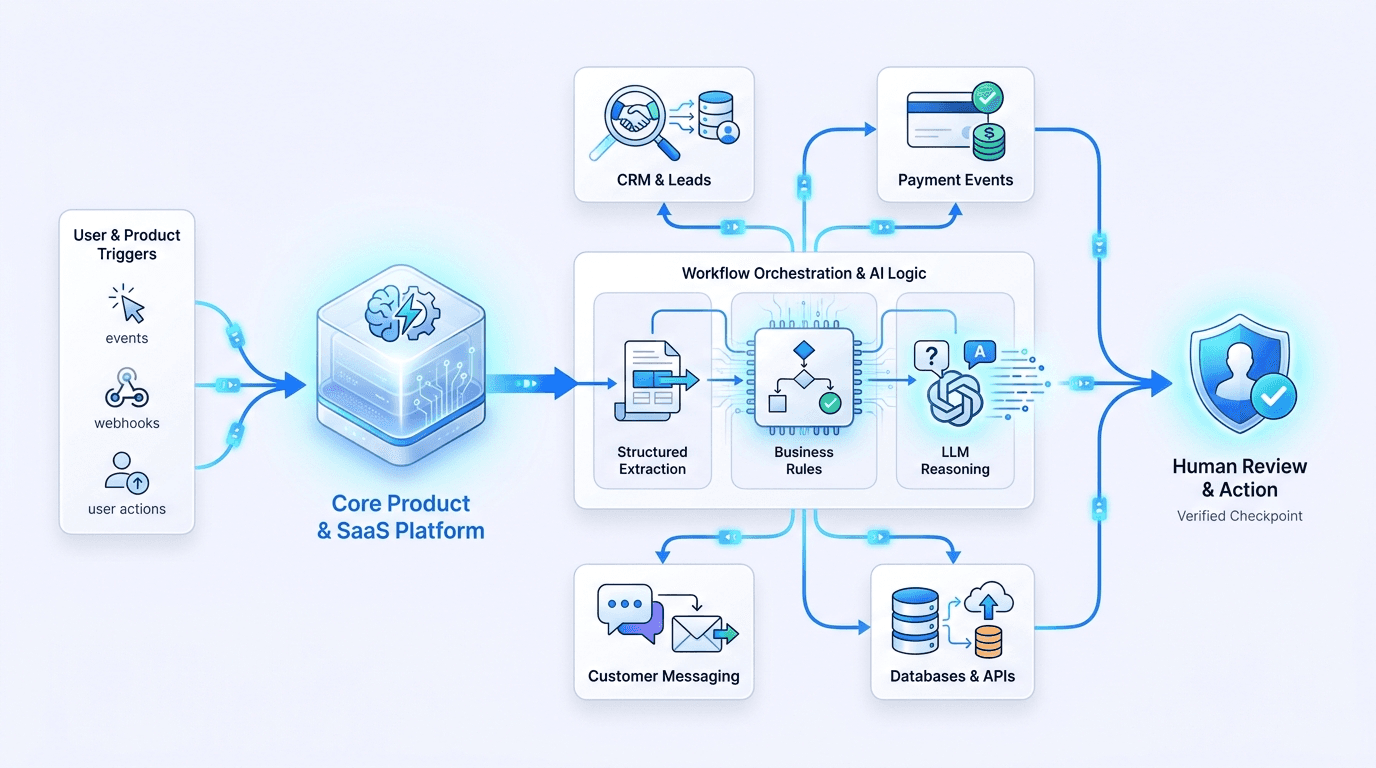
Reliable workflows are engineered as part of the product system — with triggers, validation, orchestration, business logic, AI where useful, human review, and explicit handling for failures.
Product & Triggers
User actions, product events, forms, webhooks, schedules, CRM changes, external events
Orchestration
n8n, Make, Zapier, queues, serverless workflows, scheduled jobs
Business Logic
Validation, routing, conditions, transformations, permissions, product rules
AI Layer
OpenAI, Claude, extraction, classification, RAG, structured outputs
Tools & System Access
REST APIs, webhooks, MCP-compatible tools, databases, internal services, third-party systems
Actions
Product updates, CRM actions, messages, emails, payments, tasks, documents, notifications
Review & Observability
Human approval, logging, retry paths, exception handling, error visibility
Use AI Where Rules Alone Aren't Enough
Traditional automation works well when every decision can be expressed as a rule. AI becomes useful when the workflow needs to interpret language, documents, context, user intent, or other unstructured information.
Structured Extraction
Turn emails, forms, documents, messages, or other unstructured inputs into usable structured data with strict schema validation.
Classification & Routing
Identify intent, category, priority, or workflow path before passing work to the correct product process, system, or person.
Knowledge-Aware Workflows
Use RAG and approved product or business knowledge when the workflow requires context beyond a single static prompt.
Generative Tasks
Draft responses, documents, summaries, recommendations, or internal content with clear boundaries and review points.
“AI handles ambiguity. Business rules protect the workflow. Humans remain responsible for important decisions.”
Not Every Workflow Needs an Agent
Agents are useful when a task genuinely requires multiple decisions, tools, or changing steps. Simpler deterministic workflows are often easier to maintain and more reliable.
Use Structured Automation When:
- The sequence of operations is predictable from the start.
- Fixed business logic and strict rules govern every branch.
- Deterministic sequence and 100% repeatability matter most.
- Reliability and auditability take priority over autonomy.
- A direct API call or webhook solves the task without ambiguity.
Use an Agent When:
- The execution path dynamically depends on changing run-time context.
- Several tools must be selected and composed dynamically.
- Unstructured information determines what tool or action comes next.
- Multiple intermediate reasoning steps are required prior to output.
- Bounded autonomy adds clear, quantifiable product value.
TECHNICAL NOTE: Agents can interact with approved product tools through APIs or MCP-compatible interfaces when that architecture genuinely simplifies tool access.
Automate Repetition. Keep Judgment Visible.
High-value workflows often work best when automation prepares the decision and a person controls the important action.
Typical Approval Points We Implement:
What Happens When Something Goes Wrong?
The happy path is only part of the workflow. Production automation also needs to handle missing data, duplicate events, API failures, rate limits, unexpected responses, and retries.
Pre-Flight Validation
Check inputs and enforce strict type constraints before the workflow continues down the pipeline.
Deduplication Keys
Avoid duplicate actions, double charges, or spam sends when product events or webhooks are retried.
Exponential Backoff
Handle temporary API rate limits, network timeouts, and downstream drops safely with automated retry queues.
Graceful Degradation
Provide alternate operational paths and secondary fallback models when AI or an external service fails.
Observability & Execution Traces
Make important workflow state shifts, payload dumps, and micro-failures visible through real-time monitoring.
Dead-Letter Alerting
Route terminal workflow failures and exhausted retries to the right engineer or operator instead of failing silently in the background.
From Engineering Need to Production Workflow
Understand the System
Map the product, data, integrations, constraints, and expected outcome.
Define the Workflow
Separate deterministic logic, AI responsibilities, external dependencies, and human decisions.
Engineer the Critical Paths
Build the integrations, processing, orchestration, and production AI components.
Test Failure Modes
Validate retries, malformed data, API failures, edge cases, model variation, and recovery paths.
Release & Observe
Deploy with logging, monitoring, operational visibility, and clear ownership.
“Automation should reduce operational complexity , not hide it inside an impossible-to-maintain workflow.”
Production AI & Integrations in Real Products
ZeitFilter
Multilingual AI Voice & Vendor Follow-Up
A production voice workflow that follows up with unresponsive vendors, discusses customer requirements, captures the response, and returns the outcome through product notifications and email.
AI-Assisted Quoting
AI-Assisted Quoting & Customer Workflows
A production workflow combining structured AI assistance, customer data, quoting logic, backend processing, and human involvement where judgment is required.
Verihaq
Structured AI Analysis Pipeline
An internal analysis workflow productized into a structured LLM-backed system with dedicated backend processing and a published Chrome extension.
Scrive
AI-Assisted Candidate Pre-Screening
A product workflow using AI-assisted evaluation and structured processing to support candidate screening inside a modern hiring platform.
Engineering That Can Grow With the Product
Build AI workflows and integrations as maintainable product systems with clear boundaries, observability, extensibility, and ownership as product requirements evolve.
Product + Workflow Thinking
We design automations as extensions of your core product lifecycle, preserving data consistency and high UX standards.
Workflow + Software Engineering
We bridge no-code agility with standard Git versioning, environment management, and production-grade CI/CD pipelines.
AI With Boundaries
Rigid guardrails, deterministic data schemas, and human checkpoints keep generative unpredictability contained.
API-First Ownership
No locked proprietary connectors. You retain complete ownership of logic, database schemas, and external API integrations.
What AI or Integration Problem Is Slowing the Product Down?What AI or Integration Problem Is Slowing the Product Down?
Whether it is a customer integration, unreliable AI workflow, data pipeline, webhook-heavy process, or specialist product feature, share the engineering context and we’ll help define the right production approach.Whether it is a customer integration, unreliable AI workflow, data pipeline, webhook-heavy process, or specialist product feature, share the engineering context and we’ll help define the right production approach.